


The Incoterms is an abbreviation for “International Commercial Terms.” This term represents a very useful way of communication and it’s actually aimed at reducing confusion between buyers and sellers. So, what is an incoterm? An incoterm represents a universal term that defines a transaction between importer and exporter so that both parties understand the tasks, costs, risks, and responsibilities, as well as the logistics and transportation management from the exit of the product to the reception by the importing country. Incoterms are all the possible ways of distributing responsibilities and obligations between two parties. It is important for the buyer and seller to pre-define the responsibilities and obligations for the transport of the goods.
They are a set of rules published by the International Chamber of Commerce (ICC), which relate to International Commercial Law. According to the ICC, Incoterms® rules provide internationally accepted definitions and rules of interpretation for most common commercial terms used in contracts for the sale of goods’. All International purchases will be processed on an agreed Incoterm to define which party legally incurs costs and risks. Incoterms® will be clearly stated on relevant shipping documents.
Here are the overview of Incoterms® 2023 for 11 Terms.
· Ex works is when the seller places the goods at the disposal of the buyer at the seller's premises or at another named place (i.e., works, factory, warehouse, etc.).
· The seller does not need to load the goods on any collecting vehicle. Nor does it need to clear them for export, where such clearance is applicable, but they have to provide the documents for customs declaration.
· The seller delivers the goods to the carrier or another person nominated by the buyer at the seller's premises or another named place.
· The parties are well advised to specify as explicitly as possible the point within the named place of delivery, as the risk passes to the buyer at that point.
· The seller delivers when the goods are placed alongside the vessel (e.g., on a quay or a barge) nominated by the buyer at the named port of shipment.
· The risk of loss of or damage to the goods passes when the products are alongside the ship. The buyer bears all costs from that moment onwards.
· The seller delivers the goods on board the vessel nominated by the buyer at the named port of shipment or procures the goods already so delivered.
· The risk of loss of or damage to the goods passes when the products are on board the vessel. The buyer bears all costs from that moment onwards.
· The seller delivers the goods on board the vessel or procures the goods already so delivered.
· The risk of loss of or damage to the goods passes when the products are on board the vessel.
· The seller must contract for and pay the costs and freight necessary to bring the goods to the named port of destination.
· The seller delivers the goods on board the vessel or procures the goods already so delivered. The risk of loss of or damage to the goods passes when the products are on the ship.
· The seller must contract for and pay the costs and freight necessary to bring the goods to the named port of destination.
· The seller also contracts for insurance cover against the buyer's risk of loss of or damage to the goods during the carriage.
· The buyer should note that under CIF the seller is required to obtain insurance only on minimum cover. Should the buyer wish to have more insurance protection, it will need either to agree as much expressly with the seller or to make its own extra insurance arrangements.
· The seller delivers the goods to the carrier or another person nominated by the seller at an agreed place (if any such site is agreed between parties).
· The seller must contract for and pay the costs of carriage necessary to bring the goods to the named place of destination.
· The seller has the same responsibilities as CPT, but they also contract for insurance cover against the buyer's risk of loss of or damage to the goods during the carriage.
· The buyer should note that under CIP the seller is required to obtain insurance only on minimum cover. Should the buyer wish to have more insurance protection, it will need either to agree as much expressly with the seller or to make its own extra insurance arrangements.
· The seller delivers when the goods are placed at the disposal of the buyer on the arriving means of transport ready for unloading at the named place of destination.
· The seller bears all risks involved in bringing the goods to the named place.
· DPU replaces the former Incoterm® DAT (Delivered At Terminal). The seller delivers when the goods, once unloaded are placed at the disposal of the buyer at a named place of destination.
· The seller bears all risks involved in bringing the goods to, and unloading them at the named place of destination.
· The seller delivers the goods when the goods are placed at the disposal of the buyer, cleared for import on the arriving means of transport ready for unloading at the named place of destination.
· The seller bears all the costs and risks involved in bringing the goods to the place of destination. They must clear the products not only for export but also for import, to pay any duty for both export and import and to carry out all customs formalities.
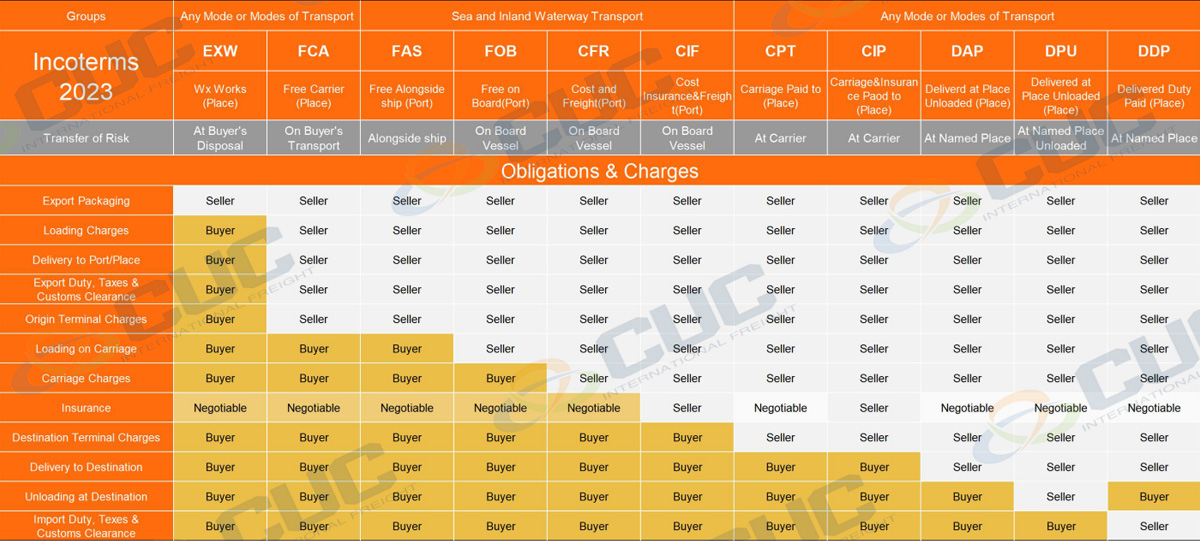
Chart showing Incoterms
Note: The content of this article and chart is only for general information purposes and shall not in any circumstances be considered bespoke legal advice or professional advice.
 What Is an Export Declaration?September 28, 2025An Export Declaration is an official document required by customs authorities to provide details about goods being shipped out of a country. It ensures compliance with trade regulations, helps governm...view
 Guides For Importing From China To USAJune 27, 2023As an importer in the USA, it is essential to have a reliable and efficient shipping partner in China. Shipping from China to the USA can be a daunting task, especially for beginners. However, with th...view
 What Is a Forwarder’s Cargo Receipt (FCR)?October 30, 2025A Forwarder’s Cargo Receipt (FCR) is an official document issued by a freight forwarder to the shipper (exporter) confirming that the forwarder has received the goods for shipment and has taken respo...view
 Door to Door vs. Port to Port in International ShippingJune 16, 2024In the realm of international shipping, choosing the right logistics strategy can significantly impact the efficiency, cost-effectiveness, and overall success of transporting goods across borders. Two...view
 English
  português
  Call us on:
  Email Us:
  International Mayors Exchange Center, No. 55 Shizhou Middle Rd, Nanshan District, Shenzhen Guangdong China
